
Commodore John Barry
- Erin Pelicano

- Apr 5, 2025
- 10 min read
Updated: May 1
The Catholic Irishman who became "Father of the American Navy"

The Irish Boy Set to Sea
Little had been mentioned about the first Commodore of the Navy in today's society. It is a shame, in my opinion, for he was a man of merit, a man of faith, and a man of selfless courage.
Commodore John Barry was born in the little village of Tacumshane, nestled within the County Wexford in Ireland. He was the oldest of five to very poor parents, James and Ellen Barry, who lived in hardship under the English rule of the draconian Penal Laws. At ten, with a desire for the sea, he was sent to his Uncle, Nicholas Barry, and became a cabin boy onboard his Uncle's merchant ship shortly after beginning his experience in learning the ropes of seamanship.
He learned to be a confident and trusting sailor under his uncle, who was also a religious man and taught him to not be ashamed of his roots, his faith, and his desire of serving. This teaching was pivotal to the young John Barry, and he carried it to his adulthood when he climbed the ladder from a cabin boy, to a seaman, then to an able-bodied seaman, a position as a Mate, and finally the rank of captain.
The Merchant Captain of Charity
During this time, he had ventured to Philadelphia many times on his voyages. Eventually, he left his native country to America in his captainship and set the stakes down for his life, and soon met and married an Irishwoman named Mary Cleary. He rose both in rank and society, with many investors in his seamanship and business of trade, eventually in a decade owning his own ship and a fine home for him and Mary, welcoming a paid servant to help in the care of Mary and the home.
He was also a very pious man, often donating to the Church he attended, relief for poor people, and eventually joining the Society for the Relief of Poor, Aged, and Infirmed Masters of Ships, and Their Widows and Children. It was both a club and an organization for those destitute by seamanship, serving and aiding many who had been out at sea. In seamanship, you look after one another, and this many of the members had continued doing with the greatest respect and dignity. Barry was renowned for modeling these values within the Society.
But then, tragedy struck him at 29, when his beloved Mary died while he was at sea. It was his brother Patrick who broke the news of his wife's death when he rowed out to meet Barry's vessel returning to port. It was hard on Barry, as he cared deeply for her. However, it was soon followed by the loss of Patrick out at sea as a privateer for the Continental Navy both Barry and Patrick volunteered to join, then news from his uncle Nicholas about the death of his parents.
While he grieved quietly for his loved ones, the dark cloud of social tension between the British Crown and the Colonists had reached a crucial cracking point from the Acts being too great on the Colonists. Sympathetic to the cause of the Colonists, and a love for his adopted homeland of America, he further offered his service to Washington.
It was hard for Barry this time, both financially and emotionally, but fortune of love happened upon him when he found and married Sarah Austin, and his new in-laws, who too were sympathetic to the cause, helped the young couple financially for some time. Barry was also a good and close friend to William Austin, a Loyalist to the crown who had gotten him and his family into financial ruin and smeared by his actions. However, Barry was compassionate to his brother in law and ensured with Washington - who was an admirer of Barry's - that his brother-in-law would not suffer death. Washington made sure that William would remained exiled, but alive and unharmed. He lived relatively well in South Carolina, and kept correspondences with Barry regularly with much care and brotherly love.
War’s end had found Barry very broke from his hand in it. He wrote to General Anthony Wayne, his partner in a cattle roundup that once helped feed Washington’s army during the Valley Forge in winter, to loan him $200 to help him and Sarah. Unfortunately, Wayne didn’t have the money either, but Barry found another way to regain some pay to live on for him and his Sarah.
Soon, more sad news had arrived from Ireland from his brother-in-law Thomas Hayes. Barry’s sister Eleanor had died from disease, and Thomas was gravely ill himself and feared for his children. He went on in the letter to exclaim that Barry’s other sister, Margaret Howlin, was also widowed and she lived in poverty. As Barry had been a charitable and caring man, he had sent them contributions to aid them in hardships. Thomas told his brother-in-law that those contributions were their “only relief” and he “praised God for having such a friend” in his later days. Moved by words, and pained with grief and compassion, Barry wrote back with hope and assured Thomas that he would “prove a real father” to Hayes’ children when the time came.
Another letter soon followed after his last letter, from his uncle Nicholas. The time had come for Barry to uphold that promise. Alongside this sad news, Nicholas’ missive was decipher in nature, delivered by “Mathew Doyle a lad of good repute” whom Nicholas was sure Barry would assist in finding proper employ, being “brought up to husbandry.” His arrival signaled the beginning of a steady stream of immigrants who made their way to Barry’s doorstep; seeking lodging, employment, and counsel. At this point, Barry always had an ample supply of each.
Building the Infant US Navy & Gaining His Fortune
Over the course of the next three years, Barry joined other renowned naval officers with memorials to Congress and the Pennsylvania Assembly; chasing down agents in France and Cuba for the desired money due to them from captured prizes. The money came very slowly, but nevertheless, he gained a good fortune with it all. Luck began turning his way in 1787, with an offer to command a merchantman bound for China.
Barry was overseeing construction of the ship Asia at this time, when John Rossiter had brought his nephews safely to Philadelphia. After a while of acclimation to America from an impoverished life in Ireland, both boys surprised their uncle and desired to go to sea in his footsteps. Michael Hayes began a long association under Rossiter’s employ with immense excitement, while his brother Patrick accompanied their Uncle Barry; sailing around the world with him, all the way to China.
Few journals from this time match Patrick’s wide-eyed and innocent recounting of the long, fascinating, and dangerous voyage to Canton. He had captured everything with a young boy’s vividness and sense of adventure: storms, lightning strikes, the shocking suicide of the despondent third mate aboard the Asia, and their unbearable layover in Cape Town; where his marvel at the exotic animals of Africa is mixed with dread at such innate racism among the Africans, the Arabs, the Europeans, and among the American crewmen; even in the dispensing of justice in Africa and in America.
In his writings, Patrick noted that “3 gibbets were shed: one fore the sailors, one fore the soldiers, and one fore the Slaves” – after all, in that time, "one wouldn’t hang a white criminal on a black man’s gallows." A hard time that concerned Patrick, but he would rise a better and finer man in equality when he became a man, thanks to Barry's guidance.
As Patrick continued in his detailed descriptions, he saw bats with seven-foot wingspans and a multitude of colorful snakes while sailing alongside the Asia; dotting his description of the tricky passage through the Sunda Straits. When they finally reached Canton, Barry kept Patrick by his side in hopes of keeping him safe from abduction as well as out of the taverns and brothels where trouble would befall the boy; and though for a time he succeeded, it was not until their departure arrived where the boy met a dishonour. While in Macao, Patrick suddenly escaped his uncle’s protective supervision. His last entry in his journal merely reads, “Maddam: full of shame” – and we will never know why to this day.
Barry and Patrick soon returned home with his fortune remade, and actually "swallowed the anchor" for the next five years. With his wife Sarah’s blessing, their lovely estate Strawberry Hill, became home for the two Hayes brothers when they returned from their voyages and spent their formative years fondly and becoming fine men. Patrick even fell in love with and later married Sarah’s niece, Betsy Keen.
Around this time, Barry’s correspondence with family and friends had further begun to flourish, as did his charitable willingness to help those in need. A regular stipend was sent to his widowed sister Margaret until her death. Soon, perfect strangers began showing up at Strawberry Hill; carrying letters of introduction from this relative or that acquaintance in hopes of money or work.
Barry found himself a one-man employment service by his friends, family, and acquaintances; often finding work for craftsmen at shipyards, positions for clerks in counting houses, and sailors given a berth by recommendation from John Barry, and so on. After the city was decimated by the first outbreak of yellow fever in 1793, Barry’s fair letters of recommendation for a young Mr. Shannon’s “integrity and sobriety” had landed him a position at the Bank of the United States, while another fortunate youngster started working for another successful Irishman, the printer Matthew Carey. Barry Charges, they were called; and most carried that title like a badge of honour.
However, not all of Barry’s charges would live up to his hopeful and trusted standards. According to one account written, when a young man with the name “John Barry” - no relation to Commodore Barry as far as we know - asked Commodore Barry for assistance in getting a berth on a Ship bound to the East, Barry immediately interceded with gracefulness; securing him a second mate’s position on an Indiaman bound for Maddras, or possibly Calcutta. The grateful sailor soon left Philadelphia with a full hold onboard the ship, leaving a pregnant wife behind. Months later, Barry had learned that the man’s talents belied his name. For his constant, wretched performance to his duties, he was left behind at Bengal; abandoning his wife and baby in America due to his actions.
“I understand she goes out nursing,” Barry sadly told a mutual acquaintance, disheartened by the sailor's actions and pitying the lonely woman and her child. It was soon learned that Philadelphians had begin to know where to send any unwanted Irish castaways who came to America. When a young Irish lass arrived ashore in Philadelphia to serve in an indenture to a rich wastrel; one of such low character and crudeness that she desired to run away for freedom. That same wastrel soon sent her to Barry’s door.
All that said, Barry was first and foremost an American and adopted the title over his Irish roots. When an old acquaintance from Wexford wrote to him about buying a plot of land in the Mohawk Valley, Barry all but ordered him to Philadelphia, saying:
I am much at a loss to know whether you have a family or not and what your views can be for a man of your years to bear yourself in the woods unacquainted I presume with cutting down trees or building log houses far removed from any place to educate your children if you have any… If you can make convenient to spend a few weeks with me at Strawberry Hill within three miles of Philadelphia you cannot refuse my request as you would have a good dale of time on your hands this winter.
After another Irish friend had looked to return to their birthland of Ireland, after a lifetime in the West Indies and not sure of anywhere better, Barry was genuinely perplexed and reached out with hope. He believed that in America, “There is everything the heart could ask for here.”
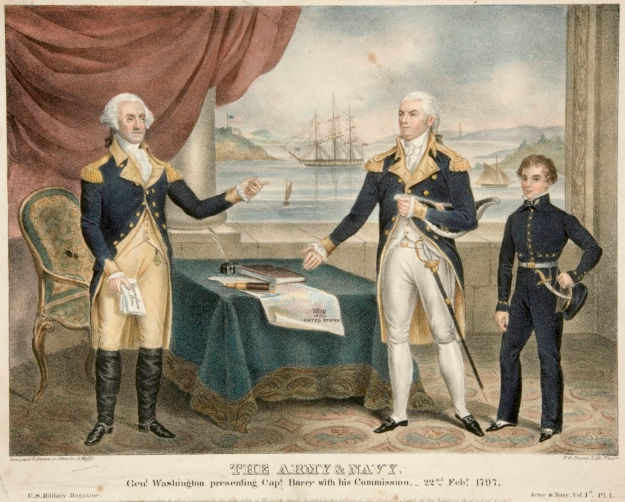
Later on in his career, President Washington had then appointed Barry the first among his captains of the new United States Navy – which was created ostensibly to protect all American shipping from the Barbary pirates that were growing vicious when the British halted their protection. Barry was justifiably proud; anxious to live up to his old friend’s expectations, and to return wholeheartedly to sea.
Now, it was thought the new navy’s ships would be built in a few months. However, they took years due to costs, delays, and issues with Congress. Barry and the others had a small concern in this time, but the ships built and sent to protect merchants succeeded, while the consulates and ambassadors to the President and Congress settled the barbary Pirates to treaties and returned any captive sailors home.
By the time they had the frigates promised set for sea and began to sail into combat in 1797, it was against a different enemy they faced in different waters. The French privateers in the Caribbean had become a problem and now they had to do real battle as a Navy. However, beset by chronic asthma and gout at this time, Barry could no longer come to his duties and be the hero of the hour. He knew he was past his prime and sadly was openly derided by President Adams and his staff. Though Barry was known to hold his head high amidst all this scornful behavior, Barry was relegated to serving as the “Mr. Chips” to the next generation of naval heroes, such as: Stephen Decatur, Richard Somers, Charles Stewart, and Oliver Hazard Perry among them.
Unfortunately, there was no smooth sailing back home. While Patrick’s career emulated his uncle’s successes as a merchant captain and a long life yet to live, his brother Michael’s life was tragically cut short when his ship was lost at sea on 1801, and no men survived to come home. Sarah was heartsick and yearned for John Barry to return to her and he remained for some time ashore to mourn Michael's passing with her. When the old Commodore, yearning for a final chance to restore his honourable reputation as a fighting sailor, received that opportunity in the form of an offer from President Jefferson to lead a squadron against the Barbary pirates that started to cause a new wave of problems for American Merchants in the Mediterranean. Unfortunately, the offer came too late as Barry was too ill to accept, “being on his last tack” as he put it somberly and remained faithful to know that he, in great hopes, was a good man for his country under God's guidance in his life.
He died months later, on September 13, 1803, and was buried in the graveyard of St. Mary's Roman Catholic Church with honours by the Navy, as much as friends and family that knew him best. He had no children of his own with Mary or Sarah, but he loved and accepted his sister's sons as his own. Therefore, the executors of his estate were his wife Sarah, his nephew Patrick Hayes, and his friend John Leamy.
Rest in Peace, Commodore John Barry, and may the Lord bless you with peaceful rest.


Comments